Showing posts with label The Kultur. Show all posts

Sunday, December 17, 2017

Globalisation!

These mooching Chinese cockwombles would like my name; also they would like a photograph that they can use in their grift.

Worryingly, they are attempting to mimic the wheedling verbal tics of the Hyderabad school of scamferences and mockademic publishing. Bad things happen if you cross the streams, people!

Here is a recent photograph. I'm the one on the right.

HTH.

Friday, July 15, 2016

Just Kidding

"Oh" the New Zild tax department might say, "there is that Another Kiwi pulling himself up by his own, and others, bootstraps and getting paid income and such. Surely the free markets, MGBTN, have no finer example of rewarding the fecklessness of some people."
And it is true, paid income and such has been happening in frightening amounts of hours if not in terms of your actual money. One finds oneself in the forefront of the New Economy and having 3, yes, THREE, zero hours contracts! Unheard of amounts of coins are falling down the edges of the New Zild societal couch.
One must also make a strong recommendation for accepting any offers of Steamed Potato tasting work. A nice little earner and free steamed potato. I kid you not. Also milkshake lollies, for free, what a time to be alive!
In an attempt to spread the new found wealth of nations throughout the nation I sallied forth to a coffee kiosk which is cunningly situated right alongside the pathway from the carpark to the lecture theatres at the university where I am triply blessed.
 Noticing that there was no one else waiting there and with the same spirit of daring-do that inspired me to pull my straps up through my boots I vouchsafed to the kiosk inmate that I would like some coffee.
"Certainly, good sir" that unfortunate replied "and may I say that you have the scruffy old geezer look down good and proper"
"Why thank you" I answered "I have been tasting steamed potatoes"
"Ah hah" he said and stepped behind the safety shield provided to all who have to deal with uncaffeinated students.
Whilst he unlocked the bean safe and filled out the forms for the sugar dispensing unit my mind resumed it's usual flibbertigibbet motion around various projects that I am involved in now..
How had the 19 rabbits got into the -20C freezer during 2009? No one remembers putting them in there and the rabbits would not have been able to write "2009 Rabbits" on the side of the bag. And why did they all decide to hop in there? 2009 was not a great year but hardly bad enough for a mass rabbit "Bugger this, we are all going to freeze ourselves". Or was it? I confess to being somewhat out of the loop in Leporidae current affairs.
Maybe 2009 was a bad year for rabbits being one year after the Global Financial Crisis which may have impacted on the price of carrots.
Or was it some rabbit equivalent of Charles Manson "Look if we all hop in the bag and throw ourselves in the freezer, the pigs will all just go away". I just don't know. Maybe the unexplained Stoat at the other end of the freezer could tell us.
Also I was pleased to see plenty of Taq Polymerase in there and a "Cloning Kit"
Then my mind was sharply interrupted by a message on the Coffee kiosk radio. Apparently 50,000 Kiwis had gone missing in the last 10 years! I was surprised having heard nothing of the loss of a provincial centre amount of people. You would think someone would say something i.e. "Oh look Taupo has gone. That's unusual". And not such a bad thing, maybe some people, not me, would say.
But no, the Deep Voiced Radio Person assured me it was not an actual place but BEEBIES!
This, I thought, was really bad. People get quite attached to their children and marauding Vikings stealing them would lead to societal problems down the line.
Where would they keep them I wondered, in big camps?  Wouldn't someone say something.? Perhaps, and this is entirely possible, it is some new society thing I don't know about such as Pokemon Go.
 I know that Scandinavian countries have good child-care provisions but does that run to marauded babies?
Deep Voice Radio person then told me the whole story. IT WAS ABORTIONS!! Stealing away potential kiwis and causing irreparable damage to something or another. If I felt strongly enough about this I should send money to them because it is very expensive to have Deep Voiced Radio People telling me about the loss of potential kiwis.
I wanted to ask DVRP about how the extra 50,000 would fit in given that we don't have enough houses for those that didn't get stolen by marauding abortionists.
Is there an empty town somewhere in NZ with bitter town planners still waiting, waiting.
This is when I started to laugh, of course, since the grift is always amusing and in terms of effectiveness the action it takes is similar to farting at a hurricane. NZ has moved on a bit, in general while, of course, there are always some rubes to be fleeced.
I wondered how the radio for the kiosk is chosen, noting that the inmate had earphones on and was crouched over a laptop when I arrived and making disc spinning DJ motions with his hands. Certainly he did not say "Here's your coffee, how about those 50,000 potential children then?" "Buy them a potential coffee" I would have cheerfully replied.

Monday, December 14, 2015

Timequake: force INFINITY

Remember Tim Burton's production of Dr Who, with Johnny Depp in the role of Davros, which he modelled after Rottwang in Metropolis? And the personal-robot Sherman Cyberman from the same assembly line as the admirable Kryten from Red Dwarf? NO WAIT that never happened in this time-line, but we did get the next best thing, which is Millennium.

Millennium has the production standards of a Blake's 7 episode and the performance conventions that you see in early Cronenberg fillums, and take to be an expression of his Ballardian themes of dehumanisation and the deaths of affect and personal connection, until they show up in every other movie from that milieu. It has sexual politics from the 1970s, with characters all querulous about Women's Lib, and special effects from the 1960s. Mixed in with 1980s New Romantics hair styles, which evidently will be born again in the distant dying future, along with grimy black-leather uniforms made all the more dystopian and cyberpunk by glueing on IC chips.
It is as if the script fell through a time-slip, collapsing decades and accreting layers of temporal artefact.
I think I have a new favourite bad movie.

In these metal ways, in these metal days
[We get mail]

Dear Riddled, I am VERY CONCERNED about the growing trend for groups of loud shouty people to feed their cats with hairy spiders and use the inevitable spider-leg-related regurgitation as their band logos. Do you know which species of spiders they are using for this purpose? I hope it is not endangered.
Yours, Anonymous
PS Please excuse Throgmorton from work this week as he has strained a vocal chord shouting in his band "Epstein Borreliosis AIDS".

Dear Grannie van Holsterin,
Your concerns are fortunately misguided. It happens that the semiotics and aesthetics of Death Metal logos have been the subject of recent academic debate (Myers 2015). The recurring themes of illegibility and Cthulhu-like fractal tentacularity are indeed a striking example of convergent evolution at work. However, no spiders are involved, not even squashed between folded pages in the manner of a Rorschach test, despite their palindromic degree of symmetry.

Discreet inquiries at the Valhalla Viking Bar and music venue revealed that the same convergent evolution is occurring independently in the Southern Hemisphere.*

It has been hypothesised by certain members of the Riddled Institute of Advanced Study and Paper-Dart design (who shall remain nameless) that the symmetry evolved by serving as a signal of fitness thereby increasing reproductive success. The consensus view, however, ascribes it to the oeuvre of Scott Kim, creating a stable attractor in the morphogenic field through the workings of morphic resonance.
This theory gains credence from the splattery appearance of Druillet graphics and horror-movie typography,** clearly influenced by the stable attractor propagating backwards along the temporal axis (as is so often the case).


* Discovery of the fine ales on tap at Valhalla led to a progressive reduction in the discretion of subsequent inquiries.

** As any fule kno, the climactic scene in Evil Aliens is accompanied on the soundtrack by "Combine Harvester", hit single from the Wurzels, leading exponents of the musical genre of Scrumpy-&-Western. This is RELEVANT TO OUR INTERESTS because Alestorm -- leading exponents of the musical genre of Pirate Metal -- have been known to cover Wurzels tracks; also, Alestorm have played at Valhalla, and THUS THE CIRCLE DOTH CLOSE.

Until last Wednesday I had never heard of Scrumpy-&- Western, nor Pirate Metal, but "filling our heads with useless knowledge and our bloodstreams with cheap beer" is the price we are willing to pay to keep our readers informed.

Thursday, April 30, 2015

O tempura, O morays

American culture has always rated Youth too highly, other parents have always over-indulged their children, and this dotage has always been reaching an unprecedented level. Thus it has always been, so the basic precepts of Burkean conservatism decree that it will always remain thus in the future.

Ha ha silly Uncle Smut! Have you been at the Rosehip-&-Nightshade parsnip scrumpy again?

To shut the pieholes, disrespectful whippersnappers. It contains vitamins and everything for health. Also, if one's parents criticised their contemporaries for sloppy permissive parenting, while one's grandparents were critical of parenting practices in their generation, then it is TRADITION.

It also contains the bones of small animals.

The parsnip scrumpy? Filtering it ruins the flavour. Now give me back my ear-trumpet and I will tell you a story.

We struggle to conceal our enthusiasm.
Via Yastreblansky, here's Randall Jarrell with a few words from 'Pictures from an Institution' (1954). The character of Irene Rosenbaum is a satire on bumptious numpties who open their faceholes and let the facile uninformed generalisations fall out.
A conservative columnist and 1960s revanchist whom we shall address as GFW somehow fell under a contractual obligation or geas to cite the book at decade intervals.

He should have read the fine print in his Faustian bargain.

Indeed he should have. Don't interrupt.

Sorry Uncle Smut.

Starting in 1980, in a syndicated Summer reading list, the book was a "wickedly funny dissection of contemporary liberalism".

In 1991, GFW turned the opportunity of a book review into a stalking horse to bring his rhetorical flamethrower to bear upon the strawman of Liberal Juvenophilia.

Is that enough metaphors? 

The task of shoehorning additional ones into the sentence is left as an exercise for the reader. This time it was convenient for GFW's purpose to endorse Irene's ill-observed opinions as if they were Jarrell's own aperçus:
Ellis in his way, and Morrison in his, illustrate a particular fate for certain youths. In Randall Jarrell's novel "Pictures from an Institution" a foreign visitor says, "You Americans do not rear children, you incite them; you give them food and shelter and applause." The problem is juvenophilia.
Why are conservative columnists so down on Juvenal when they are always extolling the virtues of Martial ?

The aesthetic rankings of Roman poets is a mystery beyond our ken.
The "inciting children" line appears again in a 2000 column which GFW palmed off on Newsweek, but by this time it served as a generic indictment of the Culture; parental indulgence as a synecdoche for liberalism required no clarification, for it had become an automatic nervous tic. The column is literally a remix of the 1980 reading list, because Newsweek won't care.
August, the last month before the academic follies begin again, is when to read Randall Jarrell's "Pictures From an Institution" (1954). It is a hilarious--and, alas, timeless--portrait of campus culture ("they longed for men to be discovered on the moon, so that they could show that they weren't prejudiced toward moon men") and liberalism generally ("You Americans do not rear children, you incite them; you give them food and shelter and applause").
GFW's views on Juvenophilia are shared by a second salaried opinionator and Christopher Lasch impersonator 'DB', to whom our attention rolls now, much in the manner of the poet's eye. DB also believes in the damage wrought by excessive parental love (his Thanksgiving family reunions are fraught with tight-lipped silences). He believes in the importance of Mawwiage, Twoo wuv, both as economic asset and as totem of moral orthodoxy; such is DB's dedication to Mawwiage that he recently divorced from his wife and freed them both to bring other people into that desirable condition. More to the point, it turns out that DB is also a victim of the geas, forcing him to write as follows:
There are two great defining features of child-rearing today. First, children are now praised to an unprecedented degree. As Dorothy Parker once joked, American children aren’t raised; they are incited. They are given food, shelter and applause. That’s a thousand times more true today. Children are incessantly told how special they are.
Rosenbaum's blather about excessive praise for children 60 years ago has been repurposed as precedent and proof of the assertion that current levels of praise are even unprecedentedly higher.
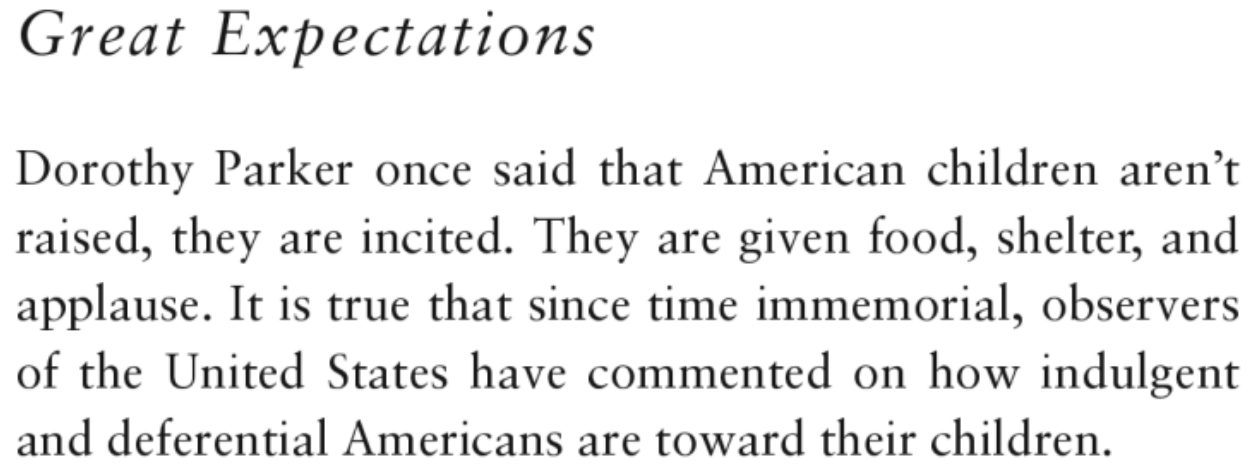
Never mind that, Uncle Smut; how did Jarrell's words get put through the Voice Empassiviser for extra flaccidity --

-- Flaccor.

Flaccor is not a word. And then put in the mouth of Dorothy Parker?

I'm glad you asked me that. It turns out that DB is plagiarising the work of one DB, a decade earlier:
Yastreblansky has a theory for how DB originally came by the misattribution which has remained ever since on his "Great Quotations" collection of fridge poetry magnets, beyond the reach of fact-checking or correction. Or perhaps it's a geas.

As a way of paying homage to the Ouroborean self-plagiarism self-sufficiency, the intellectual Biosphere 2 that American conservative thought has become, this post is a recycled version of Yastreblansky's inquiries, and of blog comments here and here.

Sunday, February 1, 2015

Visions of a parallel world: Full of sound and fury, signifying nothing

Choosing one's literary-criticism name is as important as the choice of one's porn name, although the process does not seem to be as formalised. It helps to have a double-barrelled hyphenate first name along the lines of Jean-Paul, but if the components do not exude continentality then they should be abbreviated and subordinated to a floofy middle name. By way of example, R.-L. Etienne Barnett has more cachet and élan and atelier than Richard Lawrence E. Barnett.

R.-L. Etienne has chosen to invest his prodigious talents in the dual literary métiers of (a) "Solicitation of Submissions to Guest-Edited Volumes", and (b) "Unpublication". Here is one of his productions in the former forté, an invitation of analyses of “anguish and art” in the works of Sam Beckett, for a forthcoming volume “Bleeding Jewel”:
To negotiate the Beckettian ontology is to encounter texts that often slither into transgressive recesses, slake into subversive gorges, into linguistically-intoned chasms where spiritual deadlock overtakes all but visions dissolute, allot no space to other. The discourse so birthed — extradited to the margins, to interstices, to gaps barren and unbridged — over-determines a kind of non-emergent embeddedness and challenges the very constructs of representationality. A universe of fissures, in sum, of breaches, of stultifying contraventions, critically branded as metaphor and thus perilously minimized. And yet the “poetic gleam” is everwhere apparent, unmistakably present in this universe of elegantly haunting refrain. Anguish and art: are they reconciled? Can they be? Should they be? How does each function in juxtaposition with the other? What is the ultimate vision that proceeds from a work at once so rich and so barren, so universal and so involuted, so alluring and so distancing, so stunning in its beauty and so disarming in its portrayal of vacuity?
All those chasms and gorges are a bit Third Duino Elegy, but otherwise this splendid hortatory exordium is enough in itself to vindicate Barnett's choice of inspirational sobriquet; it needs to be read aloud while looking at Jacques-Louis David artwork. The entire treasury of exegesis has been poured into it and then set in aspic in the manner of an Arman accumulation. We have requested a copy for the Riddled Library, and since the deadline for submission of manuscripts closed in September 1, 2012 --and then closed again with a deadline of April 30 2014 -- surely the final publication cannot be far away!
In a second production, R.-L. Etienne invites submissions to the guest-edited forthcoming volume “DE-BUNKING THE MUSE: LEADERSHIP IN HIGHER EDUCATION RE-ENVISIONED — NEW CONFIGURATIONS”. Such perfection must be quoted in full; one can no more truncate it than one could cut short the stream of saliva in the spittoon joke:
American higher education continues to wrestle with its own condition of never-desisting evolution. In almost every arena of university life, change is rampant. The quest for fixedness fails to yield significant results. Variables have usurped the place where constants once resided. In this optic, leadership at all levels must at once confront and effectively embrace the thorny challenges that continue to proliferate. As consequence, the leader is called upon to adopt an introspective stance so as to adopt an extrospective vision. Emergent enigmas, unanticipated challenges, altered expectations must be pro-actively and effectually counter-balanced by a compelling regeneration of creative solutions, bracing perspectives, innovative programs, focused initiatives and collaborative enterprises, all framed and under-girded by a deep-rooted respect for tradition and a concurrent, genuine and whole-hearted openness to reform. Such guiding principles, faithfully embraced, will anchor a sustainable foundation, prioritize timely and solidly-grounded values, and, one might optimistically predict, address the paramount needs and hopes of the very students we engage.
The deadline for contributions closed in September 2012 and again in March 2014, so the volume must be incredibly close to publication now!

Bartlett's accomplishments in his Unpublication oeuvre are harder to itemise for they have recently leaped ahead. As documented by Retraction Watch, he has recently unpublished an entire bloc of 13 papers from the literary-theory journal Neohelicon on account of the close similarities between them and other papers by himself and other authors. More retractions may be on the way, with Michel Charles cataloging a far-from-complete  list of textual recycling here [via Retraction Watch again].

Unsympathetic readers might apply the harsh and pejorative term "plagiarism" but they would miss the whole point of the subtractive mode of literary performance. Charles considers the possibility that "R.-L. Etienne Barnett" is in fact a Bourbakian exercise in collaorative pseudonymity, or a Borges character gone feral; the possibility of a Sokal hoax also comes to mind... but here at Riddled, we believe that Barnett has plagiarised modeled his career on that of French theorist Henri Mensonge, whose impact on post-structuralist philosophy is in inverse proportion to his almost-nonexistent literary output. As with Mensonge, no photographs exist of Barnett, nor personal websites; his CV is nowhere confined to a single site, but is rather distributed in fragments across the Interlattice.

One is also reminded of Argentinean author Federico Juan Carlos Loomis. Until now, Loomis' feat of concision and condensation -- boiling each his six books down to their single-word titles -- has had no parallel, but now he must look to his laurels.
Anyway, Barnett bears no grudges against his erstwhile colleagues at Neohelicon, and even now he is inviting submissions to a special issue he is editing for them:
Call For Papers -- DISCOURSES OF MADNESS / DISCOURS DE LA FOLIE (Neohelicon, 43, 2016 / Guest Editor: R.-L. Etienne Barnett)
Contributions on any aspect of madness in (of, and) textuality are welcome for consideration. Possible areas of focus, among a plethora of other options: literary representations of the alienated mind; mad protagonists or mad writers; madness as a vehicle of exile, as a form of marginalization, of dissipation, of disintegration, of revelation or self-revelation; interpretations of madness as a manifestation of structure, style, rhetoric, narrative; madness as a reflection of cultural assumptions, values, prohibitions; madness, as prophetic, dionysiac, poetic, or other; the esthetics of madness; philosophical, ethical, ontological, epistemological, hermeneutic and esthetic implications of the narrative or discourse of madness. 

From an alternative vantage point, one might question: how does the deviant mind-set of authorial figures and/or fictional characters determine the organization of time, space and plot in the narrative? How does the representation of delusional worlds differ from the representation of other “non-mad” mental acts (dreams, fantasies, aspirations) and from other fictional worlds (magic, imaginings, phantoms), if it does. Contributors are welcome to address these and other questions in a specific work, in a group of works, or in a more general/theoretical reflection, in and across any national tradition(s), literary movement(s) or œuvre(s).

Another of Barnett's outlets for his exercises in Unpublication is the publishing house Éditions Degré Second. Self-citations in his surviving essays refer to two books from the Degré Second imprint — En Marge: Lectures d’Excentration, and Les Enjeux du Roman: Reprises Contemporaines — but outside of the illusive realm of References sections, contingent if not parasitical, neither book appears to exist. EDS is further listed as the intended publisher of Bleeding Jewel.

Also unpublished by Éditions Degré Second is a journal with a name (Exégèse: Journal of Contemporary Studies in Applied Critical Theory), and an Editorial Board whose members boast of that select qualification on their CVs, but no issues. Nor does the absence of any domain "editionsdegresecond.be" deter Barnett from inviting correspondence through an e-address there.*

Barnett is fond of excentrating his marginala; he has also unpublished Poétique des marges: lectures d’excentration, a work-in-press. This can be glimpsed as a self-citational spectre in two barely-extant 2003 papers in Revista Letras.** The purported publisher here was Presses Universitaires du Nouveau Monde, which does exist, albeit as an egregious money-grubbing vanity publisher with no university connection.

Indeed, Barnett himself is or has been “Director of Literary Studies for the Presses Universitaires du Nouveau Monde and the University Press of the South” [UPS is an alias of PUNM: they are two buttocks of a single bum***]. This allows him a leeway which might not otherwise be available with a conventional publisher, and the influence to ensure that his unbooks do not "tunnel through" from the Dark Matter cosmos of fictive irreal literature so as to be realised as physical, observable artefacts. It is understandable, then, that the janus-headed University or Di-versity Press has been the outlet for a number of Barnett’s books, all of a vaporous nature.

Fortunately the Riddled library procurement is not hindered by mere non-existence of tomes and the Library Pixies regularly send us overdue notices for loans of Whiffle's "On the Care of the Pig" and Volume 5 of Knuth's "Art of Computer Programming".
----------------------------------------------------
* Absence of room forces us to confine Virtualities: International Review of Distance Learning to the out-takes. Barnett has been unpublishing his work there since its inaugural non-issue in Fall 2009, and it continues to resonate in his various CVs in the manner of a virtual or potential particle... not to mention the CVs of its managing editor Mary Jo Muratore, and of co-editor Anju Kanwar, neither of them troubled by the absence of duties accompanying the title.

** Cauchemars Culinaires, Nausée Narrative les Enjeux Esthétiques de la Rétrospection. I am intrigued by R.-L. Etienne's recipes and would like to subscribe to his cookbook.

*** In this comment thread the proprietor of  University Press of the South springs to the defense of his company against criticism, deploying a stream of increasingly agrammatical and ALL-CAPS sock-puppets, whose eloquent testimonials for the probity and quality of of the publisher are robbed of some effect by the alternations in the recipient of the testifying.

Wednesday, January 7, 2015

Being brought to life again meant bringing to life as well all those deeply graven reflexes of his style. He had only to pick up his pen and they overpowered him with easy automatism, no more under his control than the jerk of a finger away from a flame

"The style is the man" as the Comte de Buffoon famously vouchsafed, "Le style c'est l'homme même" (it's not entirely clear what he meant by the bit at the end about memes). Given a choice between the two, it is easier to study the style, which only requires a Goofle search, and also the Ethics committees are less complaisant about dissecting the actual man.

Now sometimes you are exposed to a sentence from a particularly self-unaware shite writer, and a word or phrase catches the eye... a dumbprint which the author is parading which such pride that you just know it will appear again and again in his secretions, in the manner of a damaged letter in typewritten text. Like lipstick on the rim of an unwashed pint glass in the Old Entomologist, or the black thumbprint on each slice of bread-and-butter served by a slovenly landlord, you know it will be back.

Cases in point are Jonah Goldberg and his thumbless grasp and Brecht reference, or "racial fides" and "grandees" in Victor Davis Hanson  Also special commendation to anarthrous occupational nominal premodifiers in Dan Brown novels. Perhaps these barbarous turns of phrase are intended as trademarks to protect the authors' text from unauthorised misuse, much as cartographers individualise their maps with fictitious settlements.

In the present red-flag-flying case a Latin tag is followed by English translation:
the Roman consul Lucius Cassius famously asked, “Cui bono?” (“To whose benefit?”)

I had a sheltered childhood in which this would be an insult to the intelligence of one's audience, and an shortcut to non-invitation back to the High Table. Perhaps the author is from a different milieu. Anyway, the recurrences were easy to find:

New Orleans was a dysfunctional city in a state with famously corrupt and incompetent leadership
“I'm a conservative,” [Jeb Bush] famously said, “but I'm not mad at everybody over it.”
Meryl Streep once testified famously before Congress
Clinton political guru James Carville famously insisted
Anne Morrow Lindbergh famously coined the phrase “wave of the future”
The New York Times famously reported on one instance
Holder famously declared in a speech that America is a “nation of cowards”
Clinton famously refused to acknowledge Barbara Feinman, the ghostwriter of her book
Victor Hugo even more famously declared
In Die Lösung Brecht famously quipped

It is as if the writer owns but the single adverb, which he uses unremittingly, like a brutal Victorian Hackneyed-cabman whipping his poor spavined horse. Are there no Societies for the Prevention of Overuse of Adverbs? Does he have no friends to club together and buy him a second adverb? Thirteen sightings from one book-shaped object:

Vanderbilt famously quipped
Lee Billinger, the president of Columbia University, famously declared
Robert Putnam, a liberal sociologist at Harvard, famously found
another famously short egomaniac
Scammon famously defined
Sheryl Crow famously proposed on her Web site
Chesterton famously observed in The Defendant
"Man is born free," Rousseau famously wrote, "but everywhere he is in chains."
Buckley was famously wrong about that
"In religion," Napoleon famously said
"If something cannot go on forever," Herb Stein famously observed, "it will stop."
Robert Ley, head of the Nazi German Labor Front, famously said
When Rabbi Hillel was famously asked to summarize the Torah

I can only hope that should I ever fall into secreting such an unrelieved, featureless stream of wordwooze, then friends and family will let all the air out of my typewriter. The message to his readership seems to be that they lack the education to recognise the fame of each [ quip / declaration / observation / event ] and need the patronising prompt to put them in a suitably reverential frame of mind.
Otherwise I will just blame the Library Pixies for typing the offending words while my attention was distracted elsewhere.

But the Riddled hospitality is unstinting and here's a longer series of sightings from a second collection of pages:

those progressive liberal journalists who famously looked out for the little guy
[Mussolini] famously responded to those who wanted specifics from him
most famously, got the "trains running on time."
Hermann Rauschnigg, an early Nazi who broke with Hitler, [...] famously dubbed
Hitler and countless other soldiers famously protested
[Bismarck] famously told the Reichstag in 1862
Bertrand Russell famously saw through the charade
He bravely fought his condition, most famously at the spa
"Take a method and try it," he famously declared
Roosevelt most famously utlized the radio
"Martial virtues," James famously wrote, "must be the enduring cement" of American society
Roosevelt's inaugural address was famously drenched with martial metaphors
Werner Sombart famously asked
the inexperienced bomb makers famously blew themselves up
JFK famously inherited this ambition from his father
More famously , [Laski] became one of Justice Oliver Wendell Holmes's [sic] closest friends
"It's my job," Holmes famously declared
[Holmes] concluded by declaring, famously
Isaiah Berlin famously argued that fascism was the progeny of the French reactionary
Ingrid Newkirk, the president of People for the Ethical Treatment of Animals, famously declared
Bush is famously pro-immigration
Philip, the famously progressive governor of Wisconsin
Lionel Trilling famously reduced conservatism to a series of "irritable mental gestures which seem to resemble ideas."

Do you think he knows he’s doing that? Maybe it’s a nervous tic or something, an "irritable nervous gesture". Let's wind up with one final example. This one's a twofer. In the absence of proper documentation for the precedence order of adverbial operators, it is not clear how to parse it.

Huey Long famously said -- or allegedly famously said -- that if fascism ever came to America it would be called "Americanism."

Allegedly famously. I'm going to stare at that sentence while it thinks about what it's done wrong.

Thursday, January 1, 2015

Derpsikorean Muse

The Converging Pasts interpretation of quondam fairy holds that a single future springs from all possible antecedents. Differences among those multiple pasts explain many disagreements with the Frau Doktorin when she reminds me of some chore I undertook to perform, but I search my memory for the promise in vain.
It was totally not my turn to feed Mrs Spat, let
alone Evangeline van Holsterin's horse Mr Kraken
As horse follows cart, as headache and recrimination follow akvavit shooters, there follow certain corollaries. One time-line exists in which the Pwn Fairy paid a pre-gristmas visit to three Washington Post journamalists and convinced them that a parody Twitter account was the official voice of the North Korean regime; while in a second time-line they recognised its satirical nature. That second non-gullible past prevailed in the superposition of quantum states, and no trace survives of the pwned-by-parody time-line, except for the parodists' screen-grab at Popehat.
The same convergence and collision of time-lines occurred for Slate writers:
Again, the skeptical past came to dominate the credulous one, which left little trace at the website apart from cryptic references to 'misstatement'.

And a third example of parody recognition at Newsweek! In that case the collision of pasts was more violent, and an apostrophe was lost in the chronorrheal turbulence:

Also the journal interviewed the people behind DPRK_News, Patrick Non-White and Derrick Eggshell.

The clash of discordant time-lines was strongest for a Fox opinionator, where the pasts could not be reconciled and a post vanished down the memory hole. In this case not one but three chronorrheal echoes of the pwned past linger on in the form of screen-grabs.

The whole saga illustrates the workings of the Morphogenetic Field. One media outlet, by putting credence in absurdist tweets as a source of information, makes it progressively easier for second, third and fourth outlets to make the same credibility-forfeiting blunder.

The alternative is that journamalists are simply reading one another's copy, and filching one another's sources without contributing any effort to confirm their accuracy. That would imply that Newsweek and WashPost are taking their cues from a Fox Opinionator -- the first in the human-centipedal chain of gullibility -- which is unpossible.

Tuesday, November 18, 2014

A Play With Words.

The Riddled Amateur Dramatic Societies Christmas Special this year is "Any Fule Knows or Ye Merry Adventures of Fule Not Luking Bak in Angre" by John Osborne
Here we the see The Fule (Smut Clyde in an award winning hat) talking to Mr Sausage Maker (myself ) and pulling a groat out of his ear. This sets up the first major joke of the evening when Mr Sausage Maker says "Do not nanny me sir, it's my groat and not yours, groper!" There will be an intermission to allow the laughter to subside. Yes, they are nice rocks on the ground. Evangeline van Holsterin's vile cousin Throgmorton got them from a man he knows. 


 Then in a largely allegorical episode the Fule takes up Nordic skiing and getting one leg stuck in a warp in the fabric of space and time. He escapes from the grip of space time whatsit by shouting "Hawk Nax" which becomes an audience interaction thing for when The Fule is in trouble.

Moving on to the sing-along section of the play The Fule wanders the streets playing his bagpipes trying to earn money but people just throw more musical instruments at him in a post-modern sort of thing than John Osborne is full of it about  has as a theme in many works. The second big laugh of the night happens here when someone yells "You can't play that, try this!"


After he has sold the instruments The Fule tries to set up a hairdressing salon where the clients are not impressed by having to be blindfolded. See Miss Dainty (Evangeline van Holsterin) saying "Not a short back and sides or I'll have your gizzards and weigh them out ". "Ooer missus" says The Fule in his trademark saying. Evangeline enjoys the sword aspect a little too much for my liking.


Then in a hallucinatory episode The Fule sets up a fashion advisory business which seems to consist of persuading people to carry dead rabbits. Ms Upright (tigris) is complaining that the rabbit is a bit elderly. "It's a bit of a hairy hare" she says. Ha ha ha we all say.  


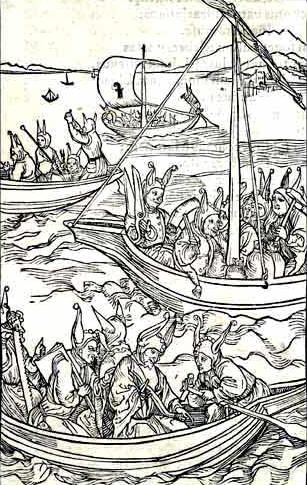
But then it all gets a bit odd and The Fule ends up sailing off to Fule land because as he says "This place is too foolish for the likes of me". He shouts "Hawk Nax" and is rescued by the Fule Navy who are out sailing in circles for no reason that is ever given (Plothole Spoiler). This is an artists impression since we only have one stage rowboat and it will just be manned by Greenish Hugh and Space Time Eddie who may or may not arrive at all.

I remain unconvinced about the flooding of the stage but Smut says it will be fine. I think we should give umbrellas to the front row people but this did cause trouble when we did "Moby Dick." The play's the thing, though eh?


Wednesday, October 8, 2014

Upward behind the onstreaming it mooned badly

At some point in the last few years, journamalists stopped promising "lunar eclipses" and took to calling them "blood moons" instead. It is as if they are following the lead and accepting the framing of the crazy-pants fundamentaliban US preachers with their End-of-Days eschatology (which appears to be all about "the moon becoming as blood"), i.e. Revelation fanfic.

That is unpossible, however, for it ascribes some influence to a tiny fringe of demented grifters, while requiring that our media are so lazy that they simply parrot back whatever phrases they have heard most recently. I am sure that "blood moon" has always been the term of choice.

UPDATE: Science fiction writers in 1973 had some weird pessimistic notions on how psychotic and isolationist American culture could become. Disch's moon-themed "Anthology of Political Forebodings" includes, among many other fine stories, Sladek's "The Great Wall of Mexico" IN ACCORDANCE WITH THE PROPHECY.

...Needs more Chrome.

Saturday, May 31, 2014

Johnny-Depp-in-Lone-Ranger Cosplay: What could possibly go wrong?

Commenting at a better blog, à propos the Laffer-curve cargo cult, Aimai wrote:
But if you were to put it into a science fiction novel the story of a society or a civilization in which the novels of Ayn Rand and something scribbled on a cocktail napkin became the basis of a new religion/economic belief system you would be laughed out of the editors meeting.
Mack Reynold's SF novelette "Coup" is set on a  planet where the crashlanded colonists lost most of their written heritage, forcing them to cobble together an eclectic tribal culture from the only two sources left to them... the Lays of Walter Scott,and Lewis Morgan's Ancient Society. The resulting melange of tartan and tomahawks, caciques and claidheamh-mòrs, is finally rediscovered by trading ships. Hilarity ensues.

The story and its two sequel novelettes were loosely bolted together into a fix-up novel.

This backstory of cultural deprivation and textual misprision was an amusing conceit in the late 60s. Not so funny when it inspired a tribe of yahoos to limit themselves to a few chapters of a single book as the base of their arts, science and worldview -- a book compiled by Middle-Eastern Bronze-Age sheepshaggers -- and then to take over US politics.

Saturday, February 8, 2014

One-part harmony: Best performed on only the white notes

Let us go then, you and I, in the Riddled time machine -- or down through the windy corridors of Memory, for those of us gifted or cursed with that old-fashioned attribute -- back 40-odd years to 1971. Oh look what we see, it is the Coca-Cola corporation investing a lot of money in an advertising campaign designed to push multiculturalism down people's throats. Not to mention sugary carbonated drinks flavoured with caffeine, tartaric and phosphoric acid.
The eventual total cost of the commercial was $250,000 — an unheard of price in 1971 for an advertisement. The finished product, first aired in July 1971, featured a multicultural group of young people lip syncing the song on a hill outside Rome, Italy. The global unity of the singers is emphasized by showing that the bottles of Coke they are holding are labelled in a variety of languages.
The theme of multiculturalism recurred in nostalgic revivals of the campaign in 2006, 2007 and 2010.
"Buy the World a Coke" was produced by Billy Davis and portrayed a positive message of hope and love sung by a multicultural collection of teenagers on the top of a hill.
So American conservatives have been putting up with this provocation for four decades but at last their patience is AT AN END. Our observers* of the human centipede of the rightwing bloggosphere inform us that the CCCorp, by recognising the existence of non-white, non-English speaking consumers persons, has made itself the recipient of a wingnut SKREEE:
Executives at Coca Cola thought it was a good idea to run a 60 second Super Bowl ad featuring children singing "America the Beautiful" – a deeply Christian patriotic anthem whose theme is unity – in several foreign languages. The ad also prominently features a gay couple....When the company used such an iconic song... to push multiculturalism down our throats, it's no wonder conservatives were outraged.
Outraged bunny IS OUTRAGED.

* More precisely, Yestreblansky, to whom we would reply directly except the Disqust commenting system no longer accepts a Google account as a way of logging in.

Friday, May 3, 2013

Hyphenation: Not just for double-barrelled English surnames

No surprises there. There is little point in courting pacifist ones.

Wednesday, October 17, 2012

Know Yore Instrument. This is the skool piano you know the one which go WAM PLUNK BISH BASH ZUNK. It is a cranky old grid made by an old german called b.ch.ei.co...ldb..rg. As you will see it hav a pair of brass flame-throwers and a bubble for a rear gunner.

The loud pedal droped off when molesworth 2 pla 'fairy bells' and hav never been seen agane. Inside there are a lot of old marbles, cig cards, toy soldiers and dead goldfish. There are a lot of wooden things which tap up and down. I think if it had a rebore and new piston rings it would be a snip.

"Prithee", quoth Another Kiwi, "let us hie to the Old Entomologist, there to partake of amber fluids and discourse of lofty issues."

"Such as?" I asked.

"Such as whether Te Papa was right to spend $1.5M on a red-painted, refigured concert piano."

The provocation for this veritable pith-up of quothing was a glance at the recent Riddled Search Terms. The list provides a salutary reminder (also minatory, and indeed hortatory) that readers are drawn to Riddled not just for the scientific knowledge that we dispense with such generosity; they also flock to learn from our views about culture.
Sadly, after three pints each of the Gumdigger Old Dalmatian (contains actual amber!) we had still not reached consensus as to the value of the purchase, or whether the piano would ideally be well-tempered or tuned in just intonation.

Instead we somehow allowed ourselves to be side-tracked onto the topic of Player Pianos as a theme in post-war literature.* Why is it, we asked ourselves, that only automated keyboard instruments have the metonym monopoly?** Why does no-one write novels called "Drum Machine" or "Serinette" when they want to express their anxieties about human redundancy and depersonalisation and the death of creativity in an increasingly automated, alienated economy? Is that fair? IS IT BOGROLL.

It was a matter of moments to find the paper napkins (head barmaid Evangeline van Holsterin doesn't hide them very well) and start designing the self-playing programmable cello. Later Evangeline threw us out for what she describes as "unbecoming conduct with the juke-box". We've been band!

Here Gustav Wolpertiger is inventing the Automatic Clockwork Bagpipes in 1822. Sadly, it never had the same social impact as the player piano, partly because the prototype was sabotaged by disgruntled Luddite pipers who replaced the tapes with their own vandalised version, and partly because no-one could tell the difference.

Below: Research by Athanasius Kircher along similar lines resulted in the invention of the automated barrel-driven dentures [includes supplementary skeleton].

Below: Another of Kircher's inventions, the Tigriphone: musical but not automatic.
Right: Bonus 1592 Tigriphone
* Riddled has 500 shiny new quatloos on offer for the person who can remember the title of the light-weight 1950s SF story, in which an organist -- disgruntled at being relegated to the role of a mere minder for the new infallible automated organ -- sabotages it by punching his own random holes into the roll for some concerto; taking to it with knives, darts and indeed his own teeth. Aleatoric performances and hilarity ensue.

** There must be something about the combination of a keyboard interface and strips of paper as a storage medium that specifically appeals to the writer's fear of being replaced by computer.